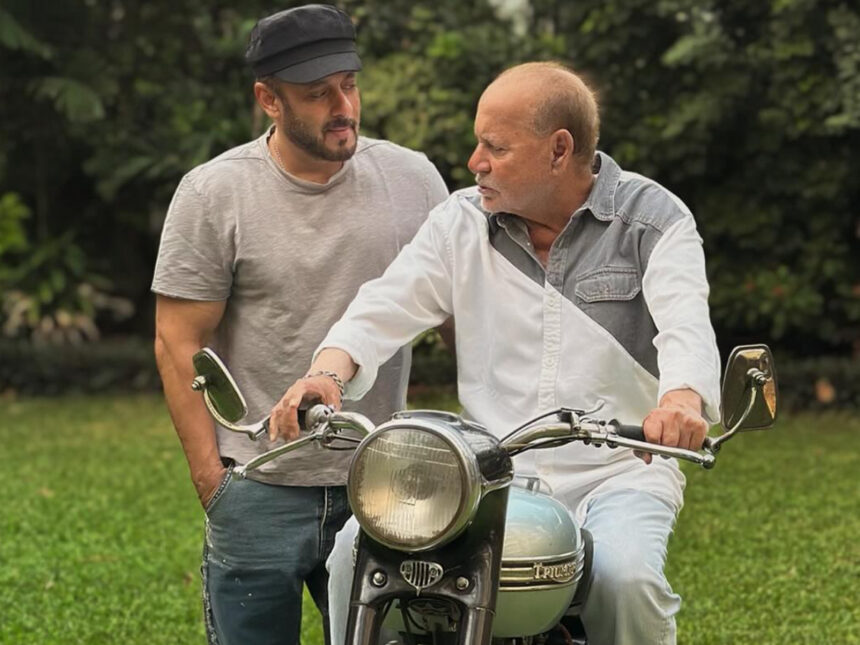
One sentence changed everything for Bollywood on the morning of February 17, 2026 — Salim Khan has been admitted to the ICU.
The legendary screenwriter who gave India its greatest films — Sholay, Deewar, Zanjeer, Don — was rushed to Lilavati Hospital in Bandra, Mumbai, after experiencing sudden giddiness at his residence. Within hours, the 90-year-old icon was diagnosed with a blood clot and placed under intensive medical care.
Salim Khan’s health has become the most searched topic in India today, as fans, colleagues, and the entire Bollywood fraternity wait anxiously for every update. His son Salman Khan abandoned his film shoot to be by his side. His family gathered en masse at the hospital. A nation held its breath.
In this comprehensive article, you will find everything there is to know about Salim Khan’s health as of today — the official medical statement word for word, a complete timeline of events, which family members are with him, a clear medical explanation of the blood clot diagnosis, and a full tribute to the man whose words shaped generations of Indian cinema.
This article is updated in real time as new information is confirmed.
Quick Answer: Salim Khan Health — Key Facts at a Glance
What happened: Salim Khan felt giddy at his Bandra home and was rushed to hospital as an emergency Diagnosis: Blood clot (confirmed by medical sources) Current status: Admitted to the ICU — vital parameters stable, overall condition serious Hospital: Lilavati Hospital & Research Centre, Bandra West, Mumbai Admitted at: 8:30 AM, February 17, 2026 Primary doctor: Dr. Jalil Parkar (ICU) Specialist team: Neurologist, Cardiologist, Neurosurgeon, and attending physicians Family present: Salman Khan, Arbaaz Khan, Helen, Alvira Agnihotri, Atul Agnihotri, Aayush Sharma, Arhaan Khan, Nirvaan Khan and more Next update: Official medical press briefing — February 18, 2026 at 11:00 AM IST
Table of Contents
- What Happened to Salim Khan? — Complete Timeline
- The Official Doctor’s Statement — Word for Word
- Blood Clot Diagnosis: What It Means at Age 90
- Family at the Hospital — Complete List
- Salman Khan Drops Everything for His Father
- Salim Khan’s Health Before This Crisis
- The Legacy of Salim Khan — Why a Nation Prays
- Bollywood and Fans React
- FAQ — Every Question Answered
- Conclusion and Live Updates
What Happened to Salim Khan? — Complete Timeline
This is the most detailed chronological account of everything that unfolded on February 17, 2026 regarding Salim Khan’s health — from the first signs of illness to the latest confirmed update.
The Early Hours — A Sudden Emergency at Home
Salim Khan began feeling unwell in the early morning hours of February 17 at his residence in Bandra, Mumbai. He experienced sudden, severe giddiness — the kind of disorienting dizziness that stops a person completely. In a 90-year-old, this symptom is never something to observe and wait out.
Family members present acted immediately. Rather than monitoring the situation at home, they made the decision that would prove to be absolutely critical: they contacted his personal physician and rushed him to hospital without delay.
8:30 AM — Emergency Admission to Lilavati Hospital
Salim Khan arrived at the emergency department of Lilavati Hospital & Research Centre, brought in by his family physician, Dr. Sandeep Chopra. Emergency care was initiated immediately upon arrival.
The attending medical team assessed his condition with urgency. Within a short time of his arrival, he was transferred to the Intensive Care Unit on the first floor of the hospital for close, continuous monitoring.
A multi-specialist team was assembled immediately — including a neurologist, a cardiologist, and a neurosurgeon — a combination that reflects the complexity and gravity of his presenting condition.
Morning to Afternoon — Blood Clot Diagnosis Confirmed
Medical assessments conducted in the early hours following admission led to the confirmation of a blood clot diagnosis. The news first became public through credentialled medical sources and was subsequently confirmed through the official hospital statement.
The confirmation spread with extraordinary speed across every media channel and social media platform in India. Within minutes, Salim Khan was the most searched name on the internet.
Afternoon — The Khan Family Gathers
As news broke, the entire Khan family mobilised. Salman Khan, Arbaaz Khan, Helen, Alvira Khan Agnihotri, Atul Agnihotri, and several other family members began arriving at Lilavati Hospital throughout the afternoon — each arrival documented by the media gathered outside.
Salman Khan, who had been on an active film shoot in Madh Island, left immediately and arrived at the hospital in a discreet but unmistakably urgent manner.
6:22 PM — Official Statement from the Hospital
The treating physician, Dr. Jalil Parkar, issued a formal public statement confirming the admission, detailing the medical team involved, and confirming that Salim Khan’s vital parameters are stable. The statement also announced that a full medical press briefing would follow on February 18 at 11 AM.
What to Expect Next
The official medical bulletin will be issued on Wednesday, February 18, 2026 at 11:00 AM IST with the consent of Salim Khan’s family. This article will be updated immediately after the briefing with the latest health status.
The Official Doctor’s Statement — Word for Word
The only confirmed, authoritative medical communication released on February 17 came directly from Dr. Jalil Parkar, the senior physician overseeing Salim Khan’s ICU care at Lilavati Hospital. His full statement:
“Yes, it’s true that Mr. Salim Khan — father of famed Bollywood actor Salman Khan and an icon in himself — has been admitted to Lilavati Hospital under my care in the ICU, early morning at 8:30 AM. He was brought into the emergency by their family doctor, Dr. Sandeep Chopra. Emergency care was initiated, and Mr. Salim Khan was shifted to the Intensive Care Unit on the 1st floor. A team of doctors consisting of Dr. Vinay Chavan (neurologist), Dr. Ajit Menon (cardiologist), Dr. Nitin Dange (neurosurgeon), and Dr. Bineet Ahluwalia attended to him. Respecting the family’s request, further details are not being shared today. A press bulletin will be held tomorrow at 11 AM with due consent of the relatives and maintaining the confidentiality of the patient to the utmost.”
Breaking Down the Statement — What Every Line Tells Us
“Admitted under Dr. Jalil Parkar in the ICU” Dr. Parkar is among the most experienced and respected critical care physicians at Lilavati Hospital. His direct involvement as the primary ICU physician confirms that Salim Khan is receiving the highest tier of critical care available in Mumbai.
“Brought in by family doctor Dr. Sandeep Chopra” The Khan family had a personal physician available who could initiate care on-site and ensure a seamless medical handover to the hospital team. Rapid, professional medical response in the critical early minutes is enormously significant in a blood clot case.
“Dr. Vinay Chavan — Neurologist” A neurologist’s presence confirms that brain function is being closely and continuously monitored. Blood clots affecting cerebral blood flow require specialist neurological assessment to track potential neurological deficits.
“Dr. Ajit Menon — Cardiologist” The heart must be fully evaluated in any blood clot case. Clots can originate from cardiac sources, or they can travel to the heart. A cardiologist’s involvement is both standard protocol and essential in this scenario.
“Dr. Nitin Dange — Neurosurgeon” This is the most clinically significant inclusion. A neurosurgeon on the active treating team signals that surgical intervention has not been ruled out. Whether surgery will ultimately be needed depends on imaging results, the clot’s precise location, and how Salim Khan responds to initial medical management.
“Stable but under close observation” This phrase requires precise interpretation. Read the medical explainer below for a full understanding of what “stable” means in an ICU context.
What “Stable” Really Means in Intensive Care
Many fans and well-wishers have taken comfort in the word “stable.” It is important to understand its precise clinical meaning so expectations are grounded in reality.
In an ICU setting, “stable” means the patient’s vital signs — heart rate, blood pressure, oxygen saturation, respiratory rate, and neurological responsiveness — are not in a state of acute, active deterioration at the time of measurement.
It does not mean the patient has recovered. It does not mean the underlying condition has been resolved. It does not mean the patient is out of danger.
Sources close to the Khan family have independently described Salim Khan’s overall condition as serious. These two characterisations — “stable vitals” and “serious condition” — are not contradictory in medicine. They reflect the nuanced clinical reality of a 90-year-old in an ICU with a confirmed blood clot.
Blood Clot Diagnosis: What It Means at Age 90
A blood clot diagnosis in a 90-year-old is a medical emergency of the highest order. To understand why the situation is being taken so seriously, you need to understand what this diagnosis actually involves.
What Is a Blood Clot?
A blood clot — medically called a thrombus — forms when blood cells, platelets, and fibrin proteins aggregate into a semi-solid mass. In response to an injury, clotting is a life-saving, automatic process. However, when a clot forms spontaneously inside a blood vessel without an external injury, it becomes an internal obstruction that can have life-threatening consequences.
The most clinically significant forms in Salim Khan’s context are:
Cerebral Venous Thrombosis (CVT): A clot in the brain’s venous drainage sinuses. Classic presenting symptoms include sudden severe headache, vision disturbances, giddiness, and vomiting. This presentation aligns closely with what has been reported in Salim Khan’s case.
Ischemic Stroke / TIA: A clot blocking an arterial blood supply to the brain, depriving brain tissue of oxygen. Giddiness and sudden instability are textbook early warning signs.
Pulmonary Embolism: A clot that originates elsewhere in the body (typically deep veins) and travels to the lungs, causing sudden breathing difficulty. Breathing problems have also been reported as a factor in Salim Khan’s admission.
The presence of both a neurologist and a cardiologist on the treating team, alongside a neurosurgeon, suggests the medical team is simultaneously evaluating multiple possibilities — standard protocol in the early hours of such a diagnosis.
Why Giddiness Is a Medical Red Flag
The specific symptom that triggered this emergency — sudden, severe giddiness — is not to be dismissed as ordinary dizziness. In medical terms, giddiness in an elderly patient can indicate:
- Reduced blood flow to the cerebellum (the brain region that controls balance and coordination)
- Vertebrobasilar insufficiency (compromised blood supply to the posterior brain)
- An acute ischemic event affecting the brain’s vestibular pathways
- Transient Ischemic Attack (TIA), often called a “mini-stroke,” which can precede a more significant event
The fact that the Khan family recognised this symptom as serious and acted immediately — rather than waiting to see if it would pass — was a medically critical decision.
Why Age 90 Makes Everything More Complex
At 90 years of age, the medical calculus of managing a blood clot becomes significantly more complicated:
Physiological reserve is reduced. The body’s capacity to compensate for impaired blood flow diminishes with age. What younger physiology can partially adapt to becomes immediately critical in a nonagenarian.
Treatment itself carries higher risk. The standard treatment for blood clots involves anticoagulant medications — drugs that prevent further clotting. In elderly patients, these medications carry a substantially elevated risk of causing dangerous internal bleeding. Doctors must calibrate dosage with exceptional precision.
Cardiovascular fragility is greater. The heart and blood vessels of a 90-year-old are less elastic and less adaptive to sudden changes in flow dynamics, making the cardiovascular burden of a clot more immediately threatening.
Neurological recovery is slower and less complete. Brain tissue in older individuals is more vulnerable to hypoxic damage (lack of oxygen), and recovery from any neurological event takes considerably longer.
This is precisely why Salim Khan’s ICU care — with six physicians involved, round-the-clock monitoring, and a neurosurgeon on standby — is not only appropriate. It is essential.
Family at the Hospital — Complete List
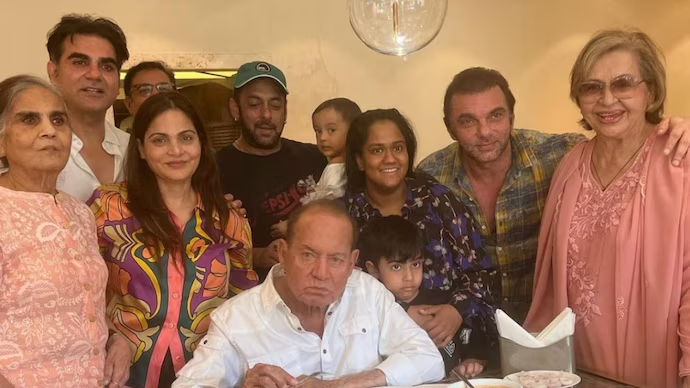
The moment news of Salim Khan’s admission became known, the entire Khan family mobilised with impressive swiftness. Here is the complete, verified list of family members confirmed at Lilavati Hospital on February 17, 2026:
| Family Member | Relationship to Salim Khan |
|---|---|
| Salman Khan | Son (eldest) |
| Arbaaz Khan | Son |
| Nirvaan Khan | Son (with Helen) |
| Helen | Wife (second marriage) |
| Alvira Khan Agnihotri | Daughter |
| Atul Agnihotri | Son-in-law (Alvira’s husband) |
| Ayaan Agnihotri | Grandson (Alvira’s son) |
| Aayush Sharma | Son-in-law (Arpita’s husband) |
| Arhaan Khan | Grandson (Arbaaz’s son) |
| Sshura Khan | Daughter-in-law (Arbaaz’s wife) |
The sheer number of family members who dropped everything to be at the hospital — from active actors to producers to teenagers — speaks more clearly than any official statement about the gravity of the situation and the central, irreplaceable role Salim Khan holds in his family’s life.
Salman Khan Drops Everything for His Father
Of all the details that emerged on February 17, 2026, perhaps none communicated the severity of the situation more powerfully than this: Salman Khan — one of the busiest and most bankable actors in Bollywood — immediately halted his active film shoot and rushed to his father’s bedside.
Salman was in the middle of production at Madh Island when the news of his father’s admission reached him. Without hesitation, work was paused. He drove directly to Lilavati Hospital.
He arrived dressed with characteristic discretion — a cap, sunglasses, and a mask, accompanied by a heavy security detail. He walked briskly through the media cluster outside the hospital without pausing, without making eye contact with cameras, without a single word to journalists. His focus was entirely, visibly, on his father.
Salman Khan has spoken in many interviews over the years about his relationship with Salim Khan. He has described his father as his most profound influence — not just professionally, but personally. The values Salman carries, the sense of loyalty he is known for, the intensity with which he protects his family — all of it, he has said, comes from watching his father.
The decision to walk away from an active shoot — to put family before box office, before deadlines, before his own star obligations — is not one Salman would take lightly. It speaks, without a single word, to how frightened he is and how much he loves his father.
Salman is currently in the midst of production on a major upcoming project. All work commitments have been placed on hold for the foreseeable future.
Salim Khan’s Health Before This Crisis
In the months leading up to February 17, 2026, Salim Khan had been publicly visible and appeared to be in remarkable health for a man of 90.
His most recent major public milestone was his 90th birthday on November 24, 2025. Photographs from the celebration showed him animated, smiling, surrounded by his children and grandchildren. He appeared engaged, alert, and deeply happy — not the picture of someone on the edge of a health crisis.
Just days before the birthday, he and his first wife Salma Khan marked their 61st wedding anniversary — a genuinely extraordinary personal milestone that was warmly celebrated.
Salim Khan has always been known for maintaining an active and disciplined personal life well into his later decades. He has spoken publicly about the importance of routine, mental engagement, and staying connected to the world around him.
No serious health events were publicly reported in the period leading up to February 17. This makes the sudden emergency all the more shocking for fans, for the industry, and for everyone who saw those birthday photos just three months ago and assumed all was well.
It is a sobering reminder of how quickly health situations can change at advanced age — and how vital it is to respond without hesitation when warning symptoms appear.
The Legacy of Salim Khan — Why a Nation Prays
To understand why the news of Salim Khan’s health has brought India to a collective standstill today, you have to understand what this man has given to Indian culture over the course of a remarkable life.
From Stuntman to Screenwriting Legend — An Extraordinary Journey
Salim Khan did not begin as a writer. He arrived in Bombay in the late 1950s as a hopeful young man and found his first foothold in the film industry as a junior artist and stuntman. The distance between bit-part extra and the most powerful screenwriter in Indian cinema history is one of the most remarkable journeys in the art form.
His creative partnership with Javed Akhtar — forged in the early 1970s — changed Indian cinema irreversibly. Together, they were simply known as Salim-Javed, and their names on a film’s poster became as powerful a commercial guarantee as any leading star. They were, in fact, the first writers in Bollywood history to successfully negotiate equal billing with the actors — a professional revolution that permanently elevated the status of screenwriters in India.
The Films That Defined a Generation
The Salim-Javed body of work is a syllabus for understanding India’s cultural history in the second half of the twentieth century:
| Film | Year | Why It Matters |
|---|---|---|
| Zanjeer | 1973 | Launched Amitabh Bachchan’s iconic “Angry Young Man” persona; redefined commercial Hindi cinema |
| Sholay | 1975 | Widely regarded as the greatest Indian film ever made; Jai and Veeru are cultural immortals |
| Deewar | 1975 | “Mere paas maa hai” — possibly the most quoted line in the history of Hindi cinema |
| Don | 1978 | Spawned decades of sequels and remakes; established the cool, enigmatic anti-hero |
| Trishul | 1978 | The definitive revenge drama; a masterclass in family conflict narrative |
| Kranti | 1981 | Epic patriotic historical; redefined the independence-era genre |
| Shakti | 1982 | The rare film featuring both Amitabh Bachchan and Dilip Kumar; a cinematic landmark |
| Mr. India | 1987 | Beloved superhero fantasy; “Mogambo khush hua” became a permanent part of Indian vocabulary |
The “Angry Young Man” — More Than a Character
Salim Khan’s single most enduring contribution to Indian culture may not be any one film, but rather the archetype he co-created with Javed Akhtar: the Angry Young Man.
In the India of the 1970s — politically turbulent, economically frustrated, and socially restless — this character gave voice to something millions of ordinary Indians were feeling but had never seen reflected on screen. The Angry Young Man was not the traditional white-clothed hero of earlier Hindi cinema. He was morally complex, shaped by injustice, defiant in the face of a broken system. He was deeply, painfully human.
Amitabh Bachchan became the face. Salim Khan and Javed Akhtar gave him the soul.
When audiences wept and cheered in equal measure, they were responding to writing that understood them. That is what Salim Khan gave India. Not just entertainment — understanding.
A Voice on Society, Not Just on Screen
In his later decades, Salim Khan stepped further into the public sphere as a thoughtful commentator on social issues. He has spoken and written about religious harmony, caste discrimination, and the responsibilities of those with public platforms — demonstrating that his influence was never limited to the dark of a cinema hall.
He is, in every meaningful sense, a man larger than any single role he has played in Indian life.
Bollywood and Fans React
The news of Salim Khan’s hospitalisation triggered one of the most immediate and widespread outpourings of concern Indian entertainment has witnessed in recent memory.
Social Media Floods With Prayer and Love
Within minutes of the news breaking, social media platforms were overwhelmed. Hashtags including #SalimKhan, #GetWellSoonSalimKhan, and #PrayForSalimKhan began trending simultaneously across India. The South Asian diaspora in the United Kingdom, the United States, Canada, the Gulf countries, and Southeast Asia joined the conversation — sharing memories of the films he wrote and sending prayers in Hindi, Urdu, English, and every language of the subcontinent.
Fans shared clips from Sholay, Deewar, and Zanjeer — not in the mode of celebration, but as a form of tribute. A way of saying collectively: Your work is in us. Please come back to us.
The Industry Responds in Solidarity
Members of the film industry have been reaching out privately to the Khan family throughout the day. Most have chosen not to make public statements, rightly prioritising the family’s need for privacy and space during an acute medical crisis. That restraint itself reflects genuine care and respect.
A close family associate, speaking with deep concern, described the mood simply: “Salim saab’s condition is serious. We are all concerned and hoping he would get back home the soonest.”
That one sentence, honest and unadorned, captures precisely what all of India is feeling today.
FAQ: Every Question About Salim Khan’s Health Answered
Q: What happened to Salim Khan on February 17, 2026?
A: Salim Khan, 90, suddenly fell unwell at his Bandra residence in Mumbai, experiencing severe giddiness. His family responded immediately, contacting his personal physician and rushing him to Lilavati Hospital in an emergency. He was admitted to the ICU and subsequently diagnosed with a blood clot. His vital parameters are currently described as stable, though his overall condition is reported as serious.
Q: Which hospital is Salim Khan admitted to?
A: Salim Khan is admitted to Lilavati Hospital & Research Centre in Bandra West, Mumbai. He is in the Intensive Care Unit on the first floor, under the primary care of Dr. Jalil Parkar and a team of six specialist physicians.
Q: What is a blood clot and why is it so serious?
A: A blood clot is a mass of clumped blood cells and proteins that blocks normal blood flow through a vessel. When a clot forms in or near the brain or heart, it can cause a stroke, brain damage, cardiac emergency, or other life-threatening complications. In a 90-year-old patient, treating a blood clot is especially complex because anticoagulant medications — the primary treatment — carry a higher risk of dangerous internal bleeding in elderly patients. The combination of age, diagnosis, and the six-physician specialist team all indicate a situation of significant medical gravity.
Q: What does “stable but under observation” mean?
A: In medical terms, “stable” means Salim Khan’s vital signs — heart rate, blood pressure, oxygen levels, and neurological responses — are not in active decline at the time of measurement. It does not mean he is out of danger or has recovered. “Under close observation” means the ICU team is monitoring him continuously around the clock, ready to respond immediately if his condition changes. Sources close to the family have separately confirmed his condition is serious.
Q: Who are the doctors treating Salim Khan?
A: The confirmed treating team at Lilavati Hospital includes Dr. Jalil Parkar (primary ICU physician), Dr. Vinay Chavan (neurologist), Dr. Ajit Menon (cardiologist), Dr. Nitin Dange (neurosurgeon), Dr. Bineet Ahluwalia (attending physician), and Dr. Sandeep Chopra (family physician who initiated the emergency response).
Q: Is Salim Khan out of danger?
A: As of the latest confirmed information on February 17, 2026, Salim Khan’s vital parameters are stable — but he has not been declared out of danger. His overall condition is described as serious. A full medical briefing is expected on February 18 at 11 AM, which will provide a more detailed health status.
Q: Did Salman Khan visit his father in hospital?
A: Yes. Salman Khan left his active film shoot at Madh Island and went directly to Lilavati Hospital to be with his father. He arrived wearing a cap, mask, and sunglasses, accompanied by his security team, and declined to speak with media, focusing entirely on his family.
Q: Which family members are currently at Lilavati Hospital?
A: The entire extended Khan family has converged at the hospital. Confirmed present are Salman Khan, Arbaaz Khan, Helen, Nirvaan Khan, Alvira Khan Agnihotri, Atul Agnihotri, Ayaan Agnihotri, Aayush Sharma, Arhaan Khan, and Sshura Khan.
Q: How old is Salim Khan?
A: Salim Khan is 90 years old. He celebrated his 90th birthday on November 24, 2025, just three months before this medical emergency.
Q: When will the next official health update be available?
A: An official medical press briefing is confirmed for Wednesday, February 18, 2026 at 11:00 AM IST. The briefing will be conducted by the treating doctors with the full consent of Salim Khan’s family. HealthGuiders.com will update this article immediately following the briefing.
Q: What films did Salim Khan write?
A: As one half of the legendary Salim-Javed writing duo alongside Javed Akhtar, Salim Khan wrote some of the most celebrated films in Hindi cinema history, including Zanjeer (1973), Sholay (1975), Deewar (1975), Don (1978), Trishul (1978), Kranti (1981), Shakti (1982), and Mr. India (1987), among many others.
Q: Why is Salim Khan considered a Bollywood legend?
A: Salim Khan co-created some of the most culturally significant films in Indian history, introducing the “Angry Young Man” archetype that resonated with an entire generation. He and Javed Akhtar were the first screenwriters in Bollywood to receive equal billing with leading stars — a revolution that permanently changed how the industry valued its writers. His influence extends beyond cinema into social commentary and public discourse, making him one of the most respected cultural figures in India.
Q: Could Salim Khan require surgery?
A: The inclusion of a neurosurgeon (Dr. Nitin Dange) in the active treating team indicates that surgical intervention has not been ruled out. Whether surgery will ultimately be needed depends on imaging findings, the clot’s precise location and size, and how Salim Khan responds to initial medical management. No surgical procedure has been confirmed or announced.
Q: What should the public know about recognising blood clot symptoms?
A: The symptoms Salim Khan experienced — sudden severe giddiness — are a known warning sign of a potential blood clot affecting the brain. Other symptoms that warrant immediate medical attention include sudden severe headache, visual disturbances, facial drooping, arm weakness, and difficulty speaking. If you or someone near you experiences these symptoms, do not wait. Call emergency services immediately. Early response is the single most important factor in outcomes.
Conclusion: A Nation Prays for Salim Khan
Salim Khan gave India its greatest stories. Today, India hopes with everything it has for his story to continue.
The 90-year-old legend who wrote Sholay‘s immortal friendship, Deewar‘s aching family drama, and Zanjeer‘s blazing righteous anger is now fighting one of the hardest battles of his remarkable life — quiet, medical, and intensely personal. But the love of a nation surrounds him in that hospital room.
Here is where things stand as of February 17, 2026:
Salim Khan was rushed to Lilavati Hospital after experiencing giddiness at his Bandra home. He was diagnosed with a blood clot and admitted to the ICU under a six-physician specialist team. His vital parameters are currently stable, but his overall condition is described as serious. His entire family — led by Salman Khan, who left his film shoot immediately — is at his side. An official medical briefing is confirmed for February 18 at 11 AM.
This article will be updated the moment new information is available. Bookmark this page for real-time updates.
From everyone at HealthGuiders.com — and from the hundreds of millions of people whose lives have been touched by the films he wrote — we send Salim Khan our deepest wishes for a full and swift recovery.
Come home soon, Salim Saab.
📌 LIVE UPDATE NOTICE: This article was last updated on February 17, 2026 at 6:45 PM IST. It is actively monitored and will be updated when the official press briefing takes place on February 18, 2026 at 11 AM IST. All information is sourced from confirmed medical statements and verified reporting.
🔴 LIVE UPDATE — February 17, 2026 | 8:15 PM IST
Latest: Salim Khan Remains in ICU — Condition Stable, Family Still at His Side
Last Verified: February 17, 2026 at 8:15 PM IST Status: Actively Monitoring — Next Official Update: February 18, 2026 at 11:00 AM IST
As of this evening, Salim Khan remains admitted to the Intensive Care Unit at Lilavati Hospital, Bandra West, Mumbai. There has been no deterioration reported in his condition since the initial hospital statement released at 6:22 PM IST.
The 90-year-old legendary screenwriter continues to be monitored round-the-clock by his six-physician specialist team under the primary supervision of Dr. Jalil Parkar.
What Is Confirmed Right Now
Condition: Stable, under close and continuous clinical observation in the ICU
Medical team: Actively present — Dr. Jalil Parkar (ICU), Dr. Vinay Chavan (neurologist), Dr. Ajit Menon (cardiologist), Dr. Nitin Dange (neurosurgeon), and Dr. Bineet Ahluwalia
Family: Both of Salim Khan’s wives — Salma Khan and Helen — have been confirmed present at the hospital, as have Salman Khan, Arbaaz Khan, Alvira Agnihotri, Atul Agnihotri, Aayush Sharma, Nirvaan Khan, Arhaan Khan, and other family members
Salman Khan: Was seen leaving the hospital premises earlier this evening dressed in a black T-shirt, cap, and mask, accompanied by heavy security — he did not make any statement to the media
Official family disclosure: The Khan family has chosen not to release an independent statement today. All communication is being channelled through the hospital’s medical team in order to protect patient confidentiality
What Remains Unknown
The hospital and the Khan family have not yet publicly confirmed the precise location of the blood clot — whether it is cerebral (brain-related), cardiac (heart-related), or elsewhere in the body. This information is expected to form part of the February 18 medical briefing.
No information about specific treatment protocols — such as anticoagulant medication, imaging results, or surgical planning — has been released. This is entirely standard ICU practice and reflects the treating team’s commitment to patient privacy.
What to Expect on February 18
A formal medical press briefing has been confirmed for Wednesday, February 18, 2026 at 11:00 AM IST at Lilavati Hospital. The briefing will be conducted by the treating doctors. It will proceed subject to the consent of Salim Khan’s family and with full respect for patient confidentiality.
This is the next point at which definitive, confirmed medical information will be available.
HealthGuiders.com will update this article immediately following the conclusion of that briefing. Bookmark this page and check back at 11:00 AM IST tomorrow for the latest.
📌 Update Log — 8:30 AM IST: Salim Khan admitted to Lilavati Hospital emergency via family doctor Dr. Sandeep Chopra — Morning: Blood clot diagnosis confirmed by medical sources — 6:22 PM IST: Official statement issued by Dr. Jalil Parkar confirming ICU admission, specialist team, and stable status — 8:15 PM IST: Condition remains stable, family present, no new clinical developments — next update February 18 at 11 AM IST
A Note on Sources
All medical facts, quotes, and details in this article are drawn from the official statement issued by Dr. Jalil Parkar of Lilavati Hospital and from verified credentialled medical and entertainment journalism covering the story on February 17, 2026. No unverified rumours or unconfirmed social media claims have been included. HealthGuiders.com is committed to accurate, responsible, and ethical health journalism at all times.
For more in-depth health content, explore related articles on HealthGuiders.com.