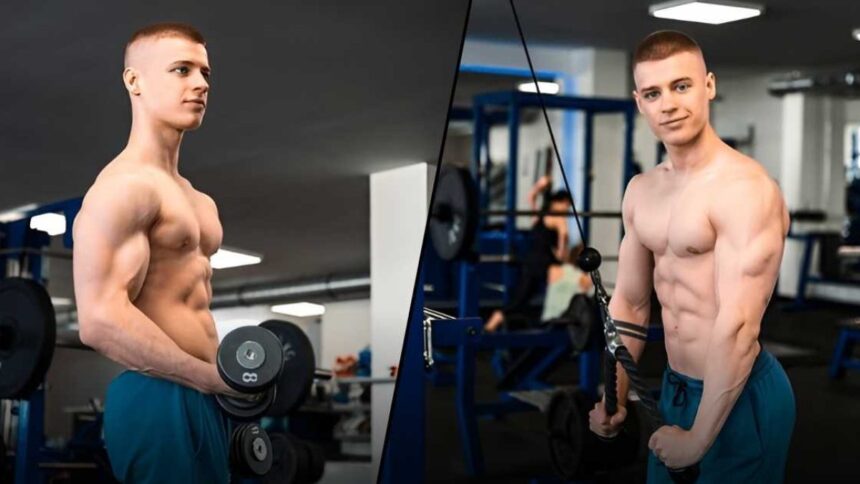
Want to fill out your shirtsleeves with powerful, well-defined arms that command respect? The secret lies in understanding and properly training your biceps and triceps—the two muscle groups that comprise the majority of your upper arm mass. Yet despite spending hours doing endless curls, many gym-goers struggle with stubborn arm development that refuses to grow beyond a certain point.
Here’s the truth: building impressive arms isn’t about randomly performing bicep curls and tricep pushdowns. It requires a strategic, science-based approach that addresses both muscle groups with proper volume, intensity, and exercise selection. According to 2025 research published in the Journal of Strength and Conditioning Research, lifters who follow structured bicep tricep programs see up to 40% greater arm circumference gains compared to those using random, unstructured approaches.
Whether you’re a beginner looking to add your first inch of arm mass, an intermediate lifter breaking through a frustrating plateau, or an advanced bodybuilder pursuing elite arm development, this comprehensive guide delivers everything you need. You’ll discover the anatomy and physiology of your biceps and triceps, proven training protocols that maximize growth, the most effective exercises backed by EMG research, optimal programming strategies, injury prevention techniques, and nutrition considerations specific to arm development.
By the end of this article, you’ll have a complete roadmap to transform your arms from mediocre to magnificent—without wasting time on ineffective exercises or falling victim to common training mistakes that derail progress.
Quick Answer Box
How Do You Effectively Train Biceps and Triceps?
Optimal bicep tricep training requires strategic programming that addresses both muscle groups with appropriate volume and intensity.
Key Training Principles:
- Frequency: Train biceps and triceps 2-3 times per week for maximum growth
- Volume: Perform 10-20 sets per muscle group weekly across all exercises
- Rep Ranges: Use 6-15 reps for hypertrophy, 3-6 reps for strength
- Exercise Selection: Include both compound and isolation movements for complete development
- Progressive Overload: Increase weight, reps, or sets every 1-2 weeks to force adaptation
- Recovery: Allow 48-72 hours between direct arm training sessions
Table of Contents
- Understanding Biceps and Triceps Anatomy
- Biceps vs Triceps: Key Differences
- The Science of Arm Muscle Growth
- Best Bicep Exercises for Mass and Definition
- Best Tricep Exercises for Horseshoe Development
- Complete Bicep Tricep Workout Programs
- Training Frequency and Volume Guidelines
- Common Training Mistakes to Avoid
- Injury Prevention and Recovery
- Nutrition for Arm Growth
- FAQ Section
- Conclusion
Understanding Biceps and Triceps Anatomy
Before diving into training protocols, understanding the anatomical structure of your arms is crucial for targeting them effectively and maximizing your results.
Biceps Brachii: The Front-Facing Muscle
The biceps brachii, commonly called “biceps,” is the prominent muscle on the front of your upper arm. Despite its name suggesting two heads, the biceps actually consists of two distinct muscle bellies that work synergistically:
Long Head (Outer Bicep)
The long head originates from the supraglenoid tubercle of the scapula (shoulder blade) and travels through the bicipital groove of the humerus. This head contributes significantly to the “peak” of your bicep when flexed and creates width when viewed from the front. The long head is particularly engaged during exercises with a narrower grip or when the arm is positioned behind your torso.
Short Head (Inner Bicep)
The short head originates from the coracoid process of the scapula and runs alongside the long head. It contributes to the thickness and fullness of your arm when viewed from the side. The short head is emphasized with wider grip positions and exercises where your arms are in front of your body.
Both heads insert on the radial tuberosity of the radius bone in your forearm. Together, they account for approximately 30-35% of your upper arm mass.
Primary Functions:
- Elbow flexion (bringing your hand toward your shoulder)
- Forearm supination (rotating your palm upward)
- Shoulder flexion (raising your arm forward)
- Glenohumeral joint stabilization
Triceps Brachii: The Rear Arm Muscle
The triceps brachii, or “triceps,” forms the entirety of the posterior (back) upper arm. True to its name, the triceps consists of three distinct heads that converge into a single tendon:
Long Head (Inner Tricep)
The long head originates from the infraglenoid tubercle of the scapula, making it the only head that crosses both the shoulder and elbow joints. This unique anatomical position means the long head is maximally engaged during overhead movements. It contributes significantly to overall arm mass and creates the distinctive “horseshoe” appearance when fully developed.
Lateral Head (Outer Tricep)
The lateral head originates from the posterior surface of the humerus, above the radial groove. It’s visible from the side and contributes to arm width. The lateral head is the most responsive to training among the three heads and typically develops fastest. It’s maximally activated during pressing and pushdown movements, particularly in the later stages of elbow extension.
Medial Head (Deep Tricep)
The medial head originates from the posterior humerus, below the radial groove. Though it lies beneath the long and lateral heads, it plays a crucial role in all tricep movements, providing consistent force throughout the range of motion. The medial head is active during all pressing movements and adds depth and density to your arms.
All three heads converge and insert on the olecranon process of the ulna (the bony prominence of your elbow). The triceps accounts for approximately 65-70% of your upper arm mass—nearly twice as large as the biceps.
Primary Functions:
- Elbow extension (straightening your arm)
- Shoulder extension (moving your arm backward)
- Shoulder adduction (bringing your arm toward your body)
- Shoulder joint stabilization, especially during overhead activities
Brachialis and Brachioradialis: The Supporting Cast
While biceps and triceps dominate arm appearance, two additional muscles contribute significantly:
Brachialis: Located beneath the biceps, this muscle adds thickness to your upper arm and assists with elbow flexion. Developing the brachialis literally pushes your biceps upward, creating a fuller appearance.
Brachioradialis: This prominent forearm muscle contributes to overall arm aesthetics and assists with elbow flexion, particularly during hammer curl variations.
Understanding Muscle Fiber Composition
Research from 2024 examining muscle fiber types in upper extremity muscles found that both biceps and triceps contain approximately 50-55% Type II (fast-twitch) fibers and 45-50% Type I (slow-twitch) fibers. This relatively balanced composition explains why arms respond well to both heavy, low-rep training (emphasizing fast-twitch) and moderate-to-high rep training (emphasizing slow-twitch and metabolic stress).
Biceps vs Triceps: Key Differences
Understanding the fundamental differences between biceps and triceps helps you program training more effectively and set realistic expectations for development.
Size and Mass Potential
Triceps Are Significantly Larger
The triceps comprise approximately 65-70% of your upper arm mass, while the biceps contribute only 30-35%. This size discrepancy has profound implications:
- Growth Potential: Pound-for-pound, tricep development contributes more dramatically to overall arm circumference
- Visual Impact: Well-developed triceps create the appearance of larger arms from all angles
- Strength Contribution: Triceps are primarily responsible for pressing strength in exercises like bench press and overhead press
According to a 2025 study analyzing arm measurements of competitive bodybuilders, those with the most impressive arm development (19+ inches) typically showed superior tricep development compared to their biceps, with average tricep-to-bicep ratios of approximately 1.8:1 in terms of volume.
Functional Roles
Antagonistic Relationship
The biceps and triceps work as antagonist muscle pairs—when one contracts, the other relaxes and stretches:
- Biceps: Function as arm flexors, responsible for pulling movements
- Triceps: Function as arm extensors, responsible for pushing movements
This relationship means that training both muscle groups creates functional balance, reduces injury risk, and improves overall upper body performance.
Athletic Transfer
Biceps are crucial for:
- Pulling movements in climbing, rowing, and grappling sports
- Carrying objects toward your body
- Throwing motions (deceleration phase)
Triceps are essential for:
- All pushing movements including blocking, punching, and pushing opponents
- Overhead throwing power
- Gymnastics movements like handstands and muscle-ups
- Swimming strokes, particularly freestyle and butterfly
Training Considerations
Load Capacity
Triceps can typically handle heavier loads than biceps due to their larger size and involvement in compound pressing movements:
- Tricep Exercises: Can use 60-80% of your body weight for exercises like close-grip bench press and dips
- Bicep Exercises: Typically limited to 30-50% of body weight for exercises like barbell curls
Recovery Requirements
Despite being larger, triceps often recover faster than biceps due to their involvement in more compound movements throughout daily life. However, both muscles respond best to 48-72 hours of recovery between direct training sessions.
Injury Susceptibility
Biceps are more prone to:
- Tendon tears, particularly in the long head attachment
- Bicipital tendonitis from overuse
- Strains during eccentric loading (lowering phase)
Triceps are more susceptible to:
- Elbow tendonitis from excessive pressing volume
- Tendon inflammation near the insertion point
- “Snapping” sensations from tendon dislocation
Aesthetic Considerations
Arm Appearance
- Biceps: Create the “peak” when flexed from the front, contributing to arm height
- Triceps: Create arm width, thickness, and the coveted horseshoe shape when flexed from the side or back
Elite bodybuilders and physique competitors focus intensively on tricep development because it contributes more dramatically to arm measurements and creates better proportions when viewed from multiple angles.
Proportional Development
For balanced arm aesthetics, most coaches recommend a training volume ratio favoring triceps:
- Beginner/Intermediate: 1:1 ratio (equal sets for biceps and triceps)
- Advanced: 1.5:1 or 2:1 ratio (more tricep volume than bicep volume)
The Science of Arm Muscle Growth
Understanding the scientific principles underlying muscle hypertrophy allows you to optimize your bicep tricep training and avoid wasting effort on ineffective approaches.
The Three Mechanisms of Hypertrophy
Recent research published in the 2025 edition of Sports Medicine identifies three primary mechanisms that stimulate muscle growth:
1. Mechanical Tension
This occurs when you lift heavy weights through a full range of motion, creating mechanical stress on muscle fibers. For arms:
- Application: Use weights in the 70-85% of 1RM range (approximately 6-12 reps to failure)
- Best For: Building overall mass and strength in both biceps and triceps
- Optimal Exercises: Barbell curls, close-grip bench press, weighted dips
2. Metabolic Stress
This results from moderate-weight, higher-rep training that creates the “pump” sensation through accumulation of metabolites like lactate and hydrogen ions:
- Application: Use weights in the 60-70% range (12-20+ reps)
- Best For: Maximizing muscle cell swelling and nutrient delivery
- Optimal Exercises: Cable curls, rope pushdowns, high-rep hammer curls
3. Muscle Damage
Controlled muscle damage from eccentric (lowering) phases stimulates repair processes that lead to growth:
- Application: Emphasize slow eccentrics (3-5 seconds) with moderate-heavy weights
- Best For: Advanced lifters seeking additional stimulus
- Optimal Exercises: Negative chin-ups, slow-eccentric dumbbell curls, tempo tricep extensions
Practical Application:
Effective arm training incorporates all three mechanisms across your weekly training volume. A sample distribution might look like:
- 40% mechanical tension (heavy, 6-10 reps)
- 40% metabolic stress (moderate, 12-20 reps)
- 20% muscle damage emphasis (eccentric-focused)
Volume Landmarks for Arm Growth
Dr. Mike Israetel’s pioneering work on training volume provides evidence-based guidelines for optimizing arm development:
Maintenance Volume (MV): 4-6 sets per muscle per week
- Minimum to maintain current muscle mass
- Appropriate during fat loss phases or deload weeks
Minimum Effective Volume (MEV): 8-10 sets per muscle per week
- Threshold where most people begin seeing measurable growth
- Good starting point for beginners
Maximum Adaptive Volume (MAV): 12-18 sets per muscle per week
- Sweet spot where most people see optimal growth
- Adjust based on individual recovery capacity
Maximum Recoverable Volume (MRV): 20-25+ sets per muscle per week
- Upper limit before recovery becomes compromised
- Only advanced lifters with superior recovery should approach this
Real-World Application:
Start at MEV and progressively add 1-2 sets per week until you identify your personal MAV. Signs you’ve exceeded MRV include:
- Persistent soreness lasting 4+ days
- Decreased performance on subsequent workouts
- Joint pain or tendonitis symptoms
- Sleep disturbances or mood changes
The Role of Progressive Overload
Progressive overload—gradually increasing training stress over time—is the fundamental principle driving all muscle growth. For biceps and triceps:
Methods of Progression:
- Increase Weight: Add 2.5-5 pounds when you can complete all prescribed reps
- Increase Reps: Add 1-2 reps per set while maintaining weight
- Increase Sets: Add an additional set to your exercises
- Improve Tempo: Slow down eccentrics or add pauses
- Reduce Rest: Decrease rest periods between sets by 10-15 seconds
- Increase Frequency: Add an extra arm session per week
Progression Timeline:
- Beginners: Can progress nearly every workout (linear progression)
- Intermediate: Progress every 1-2 weeks (block periodization)
- Advanced: Progress every 4-6 weeks (undulating periodization)
Frequency Considerations
Research comparing training frequencies found that splitting your weekly volume across multiple sessions produces superior results compared to a single arm-focused session:
Study Findings (2024 meta-analysis):
- 1x/week: Baseline growth
- 2x/week: 18% greater growth than 1x/week
- 3x/week: 12% greater growth than 2x/week
- 4x/week: No additional benefit over 3x/week (potentially counterproductive)
Practical Recommendation: Train biceps and triceps 2-3 times per week, distributing your total weekly volume across these sessions.
Best Bicep Exercises for Mass and Definition
Not all bicep exercises are created equal. Here are the most effective movements based on EMG research and practical application:
1. Barbell Bicep Curl
Why It’s Effective: Allows maximum loading potential and bilateral training efficiency. The straight bar forces pure supination, maximizing bicep activation.
Execution:
- Stand with feet shoulder-width apart, holding barbell with underhand grip
- Keep elbows fixed at your sides, curl bar toward shoulders
- Contract biceps hard at top, then lower under control (3 seconds)
- Avoid swinging or using momentum
Programming: 3-4 sets x 6-10 reps with 75-80% of your 1RM
Pro Tip: Use a shoulder-width or slightly narrower grip to emphasize the long head, or slightly wider to emphasize the short head.
2. Incline Dumbbell Curl
Why It’s Effective: The inclined position places your arms behind your torso, maximally stretching the long head and creating superior muscle activation throughout the range of motion.
Execution:
- Set bench to 45-60 degree incline
- Lie back with dumbbells hanging straight down
- Curl weights while keeping upper arms stationary
- Fully supinate (rotate palm up) at top of movement
Programming: 3 sets x 10-12 reps with moderate weight
Research Note: A 2025 EMG study found incline curls produce 15-20% greater long head activation compared to standing curls.
3. Hammer Curl
Why It’s Effective: Targets the brachialis (the muscle beneath your biceps) and brachioradialis, adding overall arm thickness and pushing your biceps upward for enhanced appearance.
Execution:
- Hold dumbbells with neutral grip (palms facing each other)
- Curl both weights simultaneously while maintaining neutral wrist
- Lower slowly and with control
- Keep elbows pinned to sides throughout
Programming: 3 sets x 12-15 reps
Variation: Perform alternating for better mind-muscle connection
4. Preacher Curl
Why It’s Effective: The preacher bench eliminates momentum and shoulder involvement, isolating the biceps. The arm position particularly targets the short head.
Execution:
- Position arms on preacher bench pad at 45-degree angle
- Hold barbell or dumbbells with supinated grip
- Curl weight while keeping upper arms pressed against pad
- Don’t allow elbows to hyperextend at bottom
Programming: 3 sets x 10-15 reps
Safety Note: Use controlled weight to prevent bicep tendon stress at the bottom position.
5. Cable Bicep Curl
Why It’s Effective: Provides constant tension throughout the entire range of motion, unlike free weights where tension decreases at certain positions. Excellent for metabolic stress and muscle pump.
Execution:
- Stand facing low cable with straight bar attachment
- Curl while keeping elbows stationary
- Squeeze hard at top for 1-2 seconds
- Control negative portion
Programming: 3-4 sets x 12-20 reps
Advanced Technique: Use drop sets on final set to maximize metabolic stress
6. Concentration Curl
Why It’s Effective: Allows complete focus on a single arm, maximizing mind-muscle connection. The seated position and braced arm eliminate almost all cheating.
Execution:
- Sit on bench with legs spread
- Place elbow of working arm against inner thigh
- Curl dumbbell while keeping upper arm completely still
- Focus on peak contraction
Programming: 2-3 sets x 12-15 reps per arm
Bodybuilding Secret: Arnold Schwarzenegger credited concentration curls as essential for developing his legendary bicep peak.
7. Chin-Ups
Why It’s Effective: A compound movement that overloads biceps with your bodyweight while simultaneously strengthening your back. Allows progressive overload through added weight.
Execution:
- Hang from pull-up bar with underhand (supinated) grip
- Pull yourself up until chin clears bar
- Lower under control to full extension
- Minimize swinging or kipping
Programming: 3-4 sets x 5-10 reps (add weight when you can do 10+ reps)
Research Data: 2024 research found chin-ups produce similar bicep activation to barbell curls while providing additional functional benefits.
8. EZ-Bar Curl
Why It’s Effective: The cambered design reduces wrist and forearm stress compared to straight bars while still allowing heavy loading. Good middle-ground option for those with wrist issues.
Execution:
- Grip EZ-bar at the angled portions
- Perform standard curling motion
- Focus on controlled eccentric
Programming: 3 sets x 8-12 reps
Optimal Bicep Exercise Selection
For Mass (Choose 2-3):
- Barbell Curl
- Incline Dumbbell Curl
- Chin-Ups
For Peak and Definition (Choose 2-3):
- Incline Dumbbell Curl
- Cable Curl
- Concentration Curl
For Complete Development (Choose 3-4):
- Barbell Curl
- Incline Dumbbell Curl
- Hammer Curl
- Cable Curl or Concentration Curl
Best Tricep Exercises for Horseshoe Development
Developing impressive triceps requires targeting all three heads with appropriate exercise selection:
1. Close-Grip Bench Press
Why It’s Effective: Allows maximum overload of all three tricep heads with heavy weight. This compound movement builds overall tricep mass and pressing strength.
Execution:
- Lie on flat bench with hands shoulder-width apart
- Lower bar to lower chest while keeping elbows tucked (30-45 degrees from torso)
- Press explosively while maintaining tucked elbow position
- Full lockout at top
Programming: 4 sets x 6-10 reps at 75-85% of regular bench press weight
Heads Targeted: All three heads, with emphasis on lateral and medial heads
2. Overhead Tricep Extension (Dumbbell or Cable)
Why It’s Effective: The overhead position places the long head on maximum stretch, making this the single best exercise for targeting this often-underdeveloped head.
Execution:
- Hold dumbbell overhead with both hands (or use cable attachment)
- Lower weight behind head by bending elbows
- Keep upper arms vertical and stationary
- Extend arms fully overhead
Programming: 3-4 sets x 10-15 reps
Heads Targeted: Primarily long head, secondary activation of lateral and medial heads
Critical Form Note: Keep elbows pointed forward, not flaring outward, throughout the movement.
3. Tricep Dips
Why It’s Effective: Bodyweight compound movement that heavily overloads all three tricep heads. Can be progressed by adding weight for continued growth.
Execution:
- Position yourself on parallel bars or dip station
- Keep torso upright to emphasize triceps over chest
- Lower until elbows reach 90 degrees
- Press back up to lockout
Programming: 3-4 sets x 8-15 reps (add weight when you can do 15+ reps)
Heads Targeted: All three heads with significant emphasis on lateral head
Modification: Use assisted dip machine or resistance bands for beginners
4. Skull Crushers (Lying Tricep Extension)
Why It’s Effective: Provides pure tricep isolation with heavy loading potential. The lying position allows maximum stretch in the bottom position.
Execution:
- Lie on flat bench holding EZ-bar or dumbbells
- Start with arms extended vertically above chest
- Lower weight toward forehead by bending elbows
- Keep upper arms stationary and angled slightly back
- Extend arms back to start position
Programming: 3 sets x 8-12 reps
Heads Targeted: All three heads with emphasis on long and lateral heads
Safety Tip: Start with lighter weight to master form—poor technique can stress elbows
5. Cable Tricep Pushdown (Straight Bar)
Why It’s Effective: Constant tension throughout movement, excellent for metabolic stress. The vertical pulling angle emphasizes the lateral head for that horseshoe appearance.
Execution:
- Stand facing cable machine with straight bar attachment at chest height
- Keep elbows pinned to sides
- Push bar down by extending elbows until arms are straight
- Control the return to starting position
Programming: 3-4 sets x 12-20 reps
Heads Targeted: Primarily lateral and medial heads
Variation: Use rope attachment for maximum peak contraction
6. Diamond Push-Ups (Close-Grip Push-Ups)
Why It’s Effective: Excellent bodyweight tricep builder requiring no equipment. Can be performed anywhere and provides significant tricep activation.
Execution:
- Get in push-up position with hands close together forming diamond shape
- Keep elbows tucked close to body
- Lower chest toward hands
- Push back up to lockout
Programming: 3 sets x 12-20 reps
Progression: Elevate feet or add weight vest as you get stronger
Research Finding: 2024 research found diamond push-ups produce nearly identical tricep activation to cable pushdowns.
7. Tricep Kickback
Why It’s Effective: Provides unique resistance curve that maximizes contraction in the lockout position. Excellent for building the mind-muscle connection.
Execution:
- Bend forward at waist, supporting yourself with non-working hand
- Start with elbow bent at 90 degrees, upper arm parallel to floor
- Extend arm back by straightening elbow
- Focus on squeezing triceps at full extension
Programming: 3 sets x 12-15 reps per arm
Heads Targeted: All three heads with emphasis on lateral head
Common Mistake: Using too much weight—focus on contraction over load
8. Bench Dips
Why It’s Effective: Accessible bodyweight exercise requiring only a bench. Great for beginners building tricep strength and endurance.
Execution:
- Place hands on bench behind you, legs extended forward
- Lower body by bending elbows to 90 degrees
- Push back up to lockout
Programming: 3 sets x 15-25 reps
Progression: Place feet on elevated surface or add weight plates to lap
Optimal Tricep Exercise Selection
For Overall Mass (Choose 3-4):
- Close-Grip Bench Press
- Dips
- Overhead Extension
- Skull Crushers
For Long Head Development (Choose 2-3):
- Overhead Extension
- Skull Crushers
- Dips
For Lateral Head/Horseshoe (Choose 2-3):
- Cable Pushdown
- Dips
- Close-Grip Bench Press
Complete Development (Choose 4-5):
- Close-Grip Bench Press
- Overhead Extension
- Dips or Skull Crushers
- Cable Pushdown
- Kickbacks or Diamond Push-Ups
Complete Bicep Tricep Workout Programs
Now let’s put the exercises together into complete, periodized programs for different training levels and goals.
Program 1: Beginner Arm Builder (8-12 Weeks)
Goal: Build foundational arm strength and size Frequency: 2x per week (e.g., Monday and Thursday) Duration: 45-60 minutes per session
Session A:
Biceps:
- Barbell Curl: 3 sets x 10-12 reps
- Hammer Curl: 3 sets x 12-15 reps
- Cable Curl: 2 sets x 15-20 reps
Triceps:
- Close-Grip Bench Press: 3 sets x 8-10 reps
- Cable Pushdown: 3 sets x 12-15 reps
- Bench Dips: 2 sets x 15-20 reps
Session B:
Biceps:
- Chin-Ups (or Assisted): 3 sets x 6-10 reps
- Incline Dumbbell Curl: 3 sets x 10-12 reps
- Concentration Curl: 2 sets x 12-15 reps per arm
Triceps:
- Dips (or Assisted): 3 sets x 8-12 reps
- Overhead Dumbbell Extension: 3 sets x 10-12 reps
- Diamond Push-Ups: 2 sets x 12-20 reps
Progression Strategy:
- Week 1-4: Master form with moderate weights
- Week 5-8: Increase weight by 5-10% when you can complete all reps
- Week 9-12: Add 1-2 reps per set while maintaining weight
Program 2: Intermediate Arm Mass Builder
Goal: Maximize arm hypertrophy Frequency: 3x per week (incorporated into push/pull/legs split) Duration: 30-40 minutes per arm session
Push Day (Triceps):
- Close-Grip Bench Press: 4 sets x 6-8 reps
- Overhead Cable Extension: 3 sets x 10-12 reps
- Cable Pushdown (Rope): 3 sets x 12-15 reps
- Tricep Kickback: 2 sets x 15-20 reps (drop set on last set)
Pull Day (Biceps):
- Barbell Curl: 4 sets x 6-8 reps
- Incline Dumbbell Curl: 3 sets x 10-12 reps
- Cable Curl: 3 sets x 12-15 reps
- Hammer Curl: 2 sets x 15-20 reps
Arms Day (Full Focus):
Superset 1 (3 rounds):
- Barbell Curl: 8-10 reps
- Skull Crusher: 8-10 reps
- Rest 90 seconds
Superset 2 (3 rounds):
- Hammer Curl: 12-15 reps
- Overhead Extension: 12-15 reps
- Rest 60 seconds
Finisher (2 rounds):
- Cable Curl: 20 reps
- Cable Pushdown: 20 reps
- No rest between exercises, 60 seconds between rounds
Progression: Increase weight by 2.5-5 lbs every 2 weeks while maintaining form
Program 3: Advanced Arm Specialization
Goal: Break through plateaus with high-volume specialization Frequency: 4x per week Duration: 6-8 weeks only (too intense for long-term)
Monday (Heavy Compound Focus):
Biceps:
- Weighted Chin-Ups: 5 sets x 5-8 reps
- Barbell Curl: 4 sets x 6-8 reps
- Incline Dumbbell Curl: 3 sets x 8-10 reps
Triceps:
- Close-Grip Bench Press: 5 sets x 5-8 reps
- Dips (Weighted): 4 sets x 6-8 reps
- Skull Crusher: 3 sets x 8-10 reps
Tuesday (Moderate Volume, Moderate Reps):
Biceps:
- EZ-Bar Curl: 4 sets x 10-12 reps
- Hammer Curl: 4 sets x 10-12 reps
- Cable Curl: 3 sets x 12-15 reps
Triceps:
- Overhead Cable Extension: 4 sets x 10-12 reps
- Cable Pushdown: 4 sets x 12-15 reps
- Kickback: 3 sets x 15-20 reps
Thursday (High Volume, Metabolic Stress):
Giant Set (4 rounds, minimal rest):
- Barbell Curl: 12 reps
- Cable Pushdown: 12 reps
- Hammer Curl: 15 reps
- Overhead Extension: 15 reps
- Rest 2 minutes between giant sets
Pump Finisher:
- Cable Curl: 3 sets x 20-25 reps
- Rope Pushdown: 3 sets x 20-25 reps
Saturday (Strength and Peak Contraction):
Biceps:
- Barbell Curl (Pause at Top): 4 sets x 8-10 reps
- Preacher Curl: 4 sets x 10-12 reps
- Concentration Curl: 3 sets x 12-15 reps per arm
Triceps:
- Close-Grip Floor Press: 4 sets x 8-10 reps
- Cable Pushdown (Slow Eccentric): 4 sets x 10-12 reps
- Diamond Push-Ups: 3 sets to failure
Deload Week (Week 7): Reduce all volume by 40% and intensity by 10-15%
Program 4: The 5/20 Method (Quick Arm Finisher)
Based on the Men’s Health protocol but optimized for maximum efficiency. Use this as a finisher after your main workout 2x per week.
Biceps Circuit (3 rounds, minimal rest):
- Chin-Ups: 5 reps
- Barbell Curl: 10 reps
- Hammer Curl: 15 reps
- Cable Curl: 20 reps
- Rest 90-120 seconds between rounds
Triceps Circuit (3 rounds, minimal rest):
- Close-Grip Bench or Dips: 5 reps
- Skull Crusher: 10 reps
- Diamond Push-Ups: 15 reps
- Cable Pushdown: 20 reps
- Rest 90-120 seconds between rounds
Total Time: 18-24 minutes Why It Works: Progressively increases metabolic stress while maintaining mechanical tension
Training Frequency and Volume Guidelines
Optimizing training frequency and volume is crucial for maximizing arm growth while managing recovery.
Frequency Recommendations by Training Level
Beginners (0-1 years training):
- Frequency: 2x per week
- Rationale: Beginners can make significant progress with lower frequencies and require more recovery time
- Example Split: Monday and Thursday, or Tuesday and Friday
Intermediate (1-3 years training):
- Frequency: 2-3x per week
- Rationale: More frequent stimulation promotes superior growth rates
- Example Split: Push/Pull/Legs with arm focus on push/pull days, plus optional dedicated arm day
Advanced (3+ years training):
- Frequency: 3-4x per week
- Rationale: Advanced lifters have superior recovery capacity and require greater frequency to continue progressing
- Example Split: Upper/Lower with arms on upper days, plus 1-2 dedicated arm sessions
Volume Guidelines
Weekly Set Targets:
| Training Level | Biceps Sets/Week | Triceps Sets/Week |
|---|---|---|
| Beginner | 8-12 sets | 10-14 sets |
| Intermediate | 12-16 sets | 14-18 sets |
| Advanced | 16-22 sets | 18-24 sets |
Important Considerations:
- Count Only Working Sets: Warm-up sets don’t contribute to volume calculations
- Adjust for Compound Movements: If you perform heavy rows and chin-ups, reduce direct bicep volume by 2-4 sets
- Individual Variation: Some people respond best at the lower end of ranges, others at higher ends
- Progressive Volume: Start at the lower end and add 1-2 sets per week until you find your maximum recoverable volume
Rest Periods Between Sets
For Hypertrophy (Muscle Growth):
- Heavy compound movements (6-8 reps): 2-3 minutes
- Moderate isolation movements (8-12 reps): 90-120 seconds
- High-rep metabolic stress (12-20+ reps): 60-90 seconds
For Strength:
- All exercises: 3-5 minutes
Advanced Techniques:
- Drop Sets: Perform set to failure, reduce weight 20-30%, continue immediately
- Rest-Pause: Perform set to failure, rest 15-20 seconds, continue for 3-5 more reps
- Supersets: Alternate bicep and tricep exercises with minimal rest (excellent for time efficiency)
Recovery Optimization
Between Sessions:
- Minimum 48 hours between direct arm training for the same muscle group
- Light pump work (high reps, low intensity) can be done daily without interfering with recovery
Sleep Requirements:
- 7-9 hours per night for optimal recovery and growth
- Sleep deprivation reduces protein synthesis by up to 20%
Nutrition Timing:
- Consume 20-40g protein within 2 hours post-workout
- Distribute total daily protein (0.7-1g per pound bodyweight) across 4-6 meals
Common Training Mistakes to Avoid
Even experienced lifters make these critical errors that sabotage arm development:
Mistake #1: Overtraining Biceps, Undertraining Triceps
The Problem: Many lifters obsess over bicep curls while neglecting triceps, leading to imbalanced arm development and limited overall size gains.
The Reality: Since triceps comprise 65-70% of arm mass, they should receive equal or greater training volume than biceps.
The Fix:
- Perform 1-1.5x more tricep volume than bicep volume
- Prioritize compound tricep movements like close-grip bench and dips
- Track your arm measurements to ensure balanced growth
Mistake #2: Using Excessive Momentum and Body English
The Problem: Swinging weights, arching your back excessively, or using hip drive shifts tension away from target muscles and increases injury risk.
The Reality: Strict form with controlled eccentrics produces superior muscle growth compared to heavier weights with poor technique.
The Fix:
- Reduce weight by 10-20% and focus on strict execution
- Film yourself to identify form breakdown
- Perform occasional slow-tempo sets (4-second eccentrics) to build control
Mistake #3: Neglecting the Eccentric Phase
The Problem: Lifters focus on lifting the weight but drop it quickly during the lowering phase, missing significant muscle-building stimulus.
The Reality: Research shows the eccentric phase may contribute 30-40% of total hypertrophic stimulus.
The Fix:
- Lower all weights under control with 2-3 second eccentrics
- Occasionally perform eccentric-emphasis sets with 4-5 second lowering phases
- Use slightly lighter weight if you can’t control the eccentric
Mistake #4: Insufficient Exercise Variety
The Problem: Performing only the same 2-3 exercises every workout leads to incomplete development and adaptation plateaus.
The Reality: Different exercises target different portions of muscles and provide varied mechanical stimuli.
The Fix:
- Rotate exercises every 4-6 weeks
- Include exercises targeting all bicep/tricep heads
- Use multiple grips (pronated, supinated, neutral) for complete development
Mistake #5: Training Arms When Fresh vs. Pre-Fatigued
The Problem: Many lifters don’t consider optimal sequencing of arm training within their overall program.
The Reality: Both approaches have merit depending on goals:
- Arms Fresh (Dedicated Arm Day): Best for maximizing arm growth in intermediate/advanced lifters
- Arms Pre-Fatigued (After Chest/Back): More time-efficient for beginners, builds work capacity
The Fix:
- Beginners: Train arms after compound movements
- Intermediate/Advanced: Dedicate 1-2 sessions per week to fresh arm training
Mistake #6: Ignoring Mind-Muscle Connection
The Problem: Mindlessly moving weights without focusing on target muscle contraction reduces muscle activation and growth.
The Reality: Studies show that actively focusing on muscle contraction increases EMG activity by 15-25%.
The Fix:
- Perform warm-up sets concentrating exclusively on feeling the target muscle
- Squeeze hard at peak contraction for 1-2 seconds
- Use lighter weights occasionally to reestablish connection
- Implement concentration curls and kickbacks specifically for connection work
Mistake #7: Inconsistent Training Frequency
The Problem: Training arms sporadically (sometimes 3x/week, sometimes skipping entirely) prevents progressive overload and disrupts recovery patterns.
The Reality: Muscle protein synthesis returns to baseline 48-72 hours after training, making consistent frequency crucial.
The Fix:
- Establish a consistent weekly schedule
- If you miss a session, don’t try to “make it up” with double volume
- Prioritize sustainable frequency over unsustainable intensity
Mistake #8: Neglecting Grip Variations
The Problem: Using only one grip type (e.g., always supinated curls) leaves portions of your arms underdeveloped.
The Reality: Different grips target different muscle emphases:
- Supinated (palms up): Maximal bicep activation
- Neutral (hammer): Emphasizes brachialis and brachioradialis
- Pronated (reverse curl): Targets forearm extensors and brachioradialis
The Fix:
- Include at least one exercise from each grip category weekly
- Rotate primary grip focus every 4-6 weeks
Injury Prevention and Recovery
Arm muscles and their associated tendons are particularly injury-prone. Here’s how to train smart and stay healthy.
Common Bicep Injuries
1. Biceps Tendonitis
Symptoms:
- Dull ache in front of shoulder or near elbow
- Pain when lifting overhead or curling
- Tenderness when pressing on tendon
Causes:
- Overuse and excessive volume
- Poor shoulder mobility limiting normal bicep function
- Sudden increases in training intensity
Treatment:
- Reduce training volume by 50% for 2-3 weeks
- Avoid overhead movements temporarily
- Apply ice after workouts (15-20 minutes)
- Consider physical therapy for persistent cases
Prevention:
- Proper warm-up including shoulder mobility work
- Gradually increase volume (no more than 10% per week)
- Include rear delt and rotator cuff strengthening
2. Biceps Tendon Tear
Symptoms:
- Sharp pain followed by popping sensation
- Visible “Popeye” deformity (bunching of muscle)
- Immediate weakness in arm flexion
- Bruising and swelling
Causes:
- Acute overload (attempting too much weight)
- Chronic tendonitis leading to weakened tendon
- Age-related degeneration (more common over 40)
Treatment:
- Immediate medical evaluation required
- Partial tears: Rest, ice, physical therapy
- Complete tears: May require surgical repair for optimal function
- Recovery: 3-6 months depending on severity
Prevention:
- Never sacrifice form for heavier weight
- Address tendonitis symptoms immediately
- Proper warm-up with progressive loading
Common Tricep Injuries
1. Triceps Tendonitis
Symptoms:
- Pain in back of elbow
- Aching that worsens with pressing movements
- Stiffness after training
Causes:
- Excessive pressing volume (combining bench press, overhead press, and tricep isolation)
- Poor elbow tracking during exercises
- Insufficient recovery between sessions
Treatment:
- Reduce pressing volume by 30-40%
- Ice after workouts
- NSAIDs for acute inflammation (consult doctor)
- Focus on cable exercises which reduce joint stress
Prevention:
- Limit total weekly pressing volume to manageable levels
- Include deload weeks every 4-6 weeks
- Ensure proper form with elbows tucked appropriately
2. Triceps Tendon Tear
Symptoms:
- Popping sensation during pressing movement
- Immediate sharp pain
- Visible gap near elbow
- Inability to extend arm against resistance
Causes:
- Acute overload during heavy pressing
- Anabolic steroid use (weakens tendons)
- Previous tendonitis creating weakness
Treatment:
- Emergency medical evaluation
- Nearly always requires surgical repair
- Recovery: 4-6 months with physical therapy
Prevention:
- Progressive overload without sudden jumps
- Address any elbow pain immediately
- Proper technique on all pressing movements
Elbow Health Strategies
Warm-Up Protocol:
- General movement (arm circles, band pull-aparts): 5 minutes
- Light cardio increasing blood flow to arms: 5 minutes
- Progressive loading:
- Set 1: Empty bar or 5-lb dumbbells x 20 reps
- Set 2: 40% working weight x 12 reps
- Set 3: 60% working weight x 8 reps
- Set 4: 80% working weight x 4 reps
Joint Health Supplements: According to recent research, these supplements may support connective tissue health:
- Collagen Peptides: 10-15g daily
- Omega-3 Fatty Acids: 2-3g EPA/DHA daily
- Glucosamine/Chondroitin: 1500mg/1200mg daily
- Vitamin C: 500-1000mg daily (essential for collagen synthesis)
Warning Signs to Stop Training:
- Sharp pain during or after exercise
- Persistent pain lasting more than 3 days
- Visible swelling or heat around joints
- Reduced range of motion
- Numbness or tingling
Implementing Deload Weeks
Every 4-6 weeks, program a deload week to manage accumulated fatigue and reduce injury risk:
Deload Protocol:
- Reduce volume by 40-50% (from 4 sets to 2 sets)
- Reduce intensity by 10-15% (use 85% of your normal working weight)
- Maintain frequency (still train arms 2-3x per week)
- Focus on perfect form and mind-muscle connection
Benefits:
- Allows connective tissue recovery
- Reduces nervous system fatigue
- Prepares body for next training block
- Reduces injury risk by 30-40% according to periodization research
Nutrition for Arm Growth
Training provides the stimulus, but nutrition provides the building blocks for muscle growth.
Protein Requirements
Daily Protein Targets:
- Active Individuals: 0.7-0.8g per pound of bodyweight
- Muscle Building Phase: 0.8-1.0g per pound of bodyweight
- During Fat Loss: 1.0-1.2g per pound of bodyweight (to preserve muscle)
Example: 180-pound lifter
- Maintenance: 126-144g protein daily
- Muscle gain: 144-180g protein daily
- Fat loss: 180-216g protein daily
Protein Distribution: Distribute protein across 4-6 meals for optimal muscle protein synthesis:
- Per Meal: 20-40g protein depending on body size
- Post-Workout: 30-40g protein within 2 hours of training
- Before Bed: 25-40g slow-digesting protein (casein or cottage cheese)
Best Protein Sources:
- Chicken breast: 31g per 4oz
- Lean beef: 28g per 4oz
- Greek yogurt: 20g per cup
- Eggs: 6g per large egg
- Whey protein: 20-25g per scoop
- Salmon: 25g per 4oz
Caloric Requirements
For Muscle Building (Surplus):
- Consume 200-500 calories above maintenance
- Emphasize clean calorie sources
- Monitor weekly weight gain: 0.5-1 pound per week is ideal
- More rapid gains indicate excessive fat accumulation
For Fat Loss (Deficit):
- Consume 300-500 calories below maintenance
- Maintain high protein to preserve muscle
- Prioritize strength training over volume to signal muscle retention
- Target 0.5-1 pound fat loss per week
For Maintenance/Recomposition:
- Consume at maintenance calories
- High protein intake (1.0g per pound)
- Emphasize progressive overload
- Patience required—slower but sustainable
Carbohydrate Strategy
Why Carbs Matter for Arms:
- Fuel high-intensity training sessions
- Replenish muscle glycogen for recovery
- Create anabolic hormonal environment
- Support training volume and intensity
Daily Carb Targets:
- Muscle Building: 2-3g per pound of bodyweight
- Maintenance: 1.5-2g per pound
- Fat Loss: 0.75-1.5g per pound
Timing Strategy:
- Pre-Workout (2-3 hours before): 40-60g carbs for energy
- Post-Workout: 40-80g carbs to replenish glycogen
- Throughout Day: Distribute remaining carbs based on activity
Best Carb Sources:
- White rice: Easily digestible, excellent post-workout
- Sweet potatoes: Nutrient-dense, steady energy
- Oats: Great pre-workout option
- Fruits: Berries, bananas provide quick energy
- Whole grain bread: Convenient, versatile
Supplement Strategy
Essential Supplements:
1. Whey Protein
- Dosage: 20-40g post-workout or between meals
- Benefits: Convenient protein source, rapidly absorbed
- Research Support: Extensive evidence for muscle protein synthesis
2. Creatine Monohydrate
- Dosage: 5g daily (loading phase optional)
- Benefits: Increases strength, work capacity, and muscle fullness
- Research: Most studied supplement, proven effective
- Arm-Specific Benefit: Increases ATP production for more reps and sets
3. Branched-Chain Amino Acids (BCAAs)
- Dosage: 5-10g during workouts (especially if training fasted)
- Benefits: Reduces muscle breakdown, supports recovery
- Note: Less necessary if consuming adequate protein
Optional Performance Enhancers:
4. Beta-Alanine
- Dosage: 3-6g daily
- Benefits: Buffers lactic acid, delays fatigue during high-rep sets
- Arm Training Application: Particularly useful for pump-focused training
5. Citrulline Malate
- Dosage: 6-8g pre-workout
- Benefits: Increases blood flow, enhances muscle pump
- Research: Improves training performance by 5-10%
6. Caffeine
- Dosage: 3-6mg per kg bodyweight (200-400mg for most)
- Benefits: Increases strength, focus, and training volume
- Timing: 30-60 minutes pre-workout
Hydration
Why It Matters:
- Muscles are 75% water
- Dehydration reduces strength by 10-15%
- Impairs recovery and protein synthesis
- Decreases muscle pump and appearance
Daily Water Targets:
- Minimum: 0.5oz per pound of bodyweight
- During Training: Add 16-24oz per hour of training
- Hot Environments: Increase by 50-100%
Example: 180-pound lifter
- Base: 90oz (11 cups) daily
- Training Day: Add 32-48oz during and after workout
- Total: 120-140oz on training days
Frequently Asked Questions
Q: How long does it take to see results from bicep tricep training?
A: Neurological adaptations and initial strength gains typically appear within 2-3 weeks of consistent training. Visible muscle growth becomes noticeable after 6-8 weeks for beginners, though this varies significantly based on genetics, nutrition, training intensity, and consistency. Advanced lifters may require 12-16 weeks to see measurable changes due to their closer proximity to genetic potential. Patience and progressive overload are essential—arm development is a marathon, not a sprint.
Q: Should I train biceps and triceps on the same day?
A: Yes, training biceps and triceps together is highly effective and time-efficient. This approach, often called an “arm day,” allows you to focus intensely on arm development while the muscles are fresh. Additionally, biceps and triceps work as antagonist pairs, meaning training one doesn’t significantly fatigue the other. Many successful bodybuilders use dedicated arm days 1-2 times weekly combined with additional arm volume on push/pull days. Alternatively, supersetting bicep and tricep exercises can increase training density and create an excellent pump.
Q: Which is more important for bigger arms—biceps or triceps?
A: Triceps are significantly more important for overall arm size because they comprise approximately 65-70% of your upper arm mass. A lifter with 16-inch arms typically has about 10.5 inches from triceps and only 5.5 inches from biceps. That said, neglecting either muscle group creates imbalanced, unaesthetic arms. For maximum arm development, prioritize tricep training slightly (1.2:1 or 1.5:1 volume ratio) while still dedicating substantial effort to bicep work.
Q: Can I train arms every day?
A: Training arms with heavy, challenging workouts every day is counterproductive and will lead to overtraining, decreased performance, and increased injury risk. Muscles grow during recovery, not during training. However, you can train arms frequently (3-4x per week) if you manage volume and intensity appropriately—never training to failure on consecutive days. Some advanced lifters use daily light pump work (10-15 minutes of easy sets) without interfering with recovery, but this requires experience and careful monitoring.
Q: How much weight should I use for bicep and tricep exercises?
A: Select weights that allow you to complete your target rep range with good form while reaching near-failure (1-2 reps left in the tank) on your final set. For hypertrophy, most people should use loads representing 70-80% of their 1RM, which typically corresponds to 8-12 rep maximums. Rather than ego-lifting with excessive weight, prioritize feeling the target muscle working throughout the range of motion. If you’re swinging, using momentum, or can’t control the eccentric phase, the weight is too heavy.
Q: Is it better to do high reps or heavy weight for arms?
A: Both approaches are valuable and should be incorporated into your training. Research shows that rep ranges from 6-20+ all effectively build muscle when taken near failure, though through different mechanisms. For optimal results, use a periodized approach: 40% of your volume in the 6-10 rep range (mechanical tension), 40% in the 10-15 rep range (combination), and 20% in the 15-20+ rep range (metabolic stress). This comprehensive approach addresses all three mechanisms of hypertrophy and prevents adaptation plateaus.
Q: Why aren’t my arms growing despite training them hard?
A: Stubborn arm growth typically stems from one or more of these issues: (1) Insufficient overall training volume—many lifters need 15-20 sets per muscle per week, (2) Poor exercise selection favoring only one or two movement patterns, (3) Inadequate nutrition, especially protein intake below 0.8g per pound of bodyweight, (4) Lack of progressive overload—doing the same weights/reps week after week, (5) Insufficient recovery due to overtraining or poor sleep, (6) Unrealistic expectations—arms grow slowly, typically 0.5-1 inch per year for intermediate lifters. Honestly assess each factor and make necessary adjustments.
Q: Do I need to do wrist curls and forearm exercises?
A: While not essential for bicep and tricep development, forearm training offers several benefits: (1) Improved grip strength allows you to handle heavier weights on arm exercises, (2) Prevents forearms from becoming a weak link that limits your performance, (3) Creates proportional, complete arm aesthetics, and (4) Reduces risk of wrist and elbow injuries. If you perform substantial pulling work (rows, chin-ups, deadlifts), your forearms likely receive adequate stimulation. Otherwise, adding 4-6 sets of wrist curls and reverse curls weekly enhances complete arm development.
Q: Should women train arms differently than men?
A: The fundamental principles of muscle growth are identical regardless of sex. Women should use the same rep ranges, exercise selection, and progressive overload strategies as men. The myth that women should only use light weights for “toning” is completely false—muscle doesn’t “tone,” it either grows or shrinks. The primary differences are: (1) Women typically have lower absolute strength levels requiring lighter loads, (2) Women may need slightly more volume (2-4 additional sets weekly) for optimal growth due to hormonal differences, and (3) Women don’t need to fear developing “bulky” arms—building significant muscle mass requires years of dedicated effort, optimal nutrition, and often genetic advantages.
Q: How long should I rest between arm exercises?
A: Rest periods should align with your training goals and the exercise intensity. For heavy, compound movements (close-grip bench, weighted chin-ups) in the 6-8 rep range, rest 2-3 minutes to allow full ATP-PC system recovery. For moderate-intensity isolation exercises (curls, extensions) in the 8-12 rep range, rest 90-120 seconds. For high-rep pump work (15-20+ reps), rest 60-90 seconds. When supersetting antagonist pairs (biceps with triceps), you can use minimal rest (30-45 seconds) between exercises since one muscle recovers while the other works.
Q: Can I build big arms without weights using only bodyweight exercises?
A: Yes, bodyweight training can build impressive arms, though equipment provides more exercise variety and easier progressive overload. Effective bodyweight arm exercises include chin-ups, pull-ups, different push-up variations (especially diamond/close-grip), dips, and inverted rows. To continue progressing, you’ll need to increase difficulty through: (1) Adding external weight (weight vest, backpack with books), (2) Changing leverage (elevating feet, single-arm variations), (3) Slowing tempo to increase time under tension, or (4) Increasing volume substantially. Elite gymnasts prove bodyweight training can build significant arm mass.
Q: Is arm soreness normal, and should I train through it?
A: Mild-to-moderate delayed onset muscle soreness (DOMS) 24-48 hours after training is normal, especially when trying new exercises or increasing volume. However, training through severe soreness that impairs your range of motion or daily activities is counterproductive and increases injury risk. Light pump work or active recovery (using 30-40% of your normal training weight) can actually reduce soreness while not impeding recovery. If soreness persists beyond 72 hours or is accompanied by sharp pain, decreased range of motion, or swelling, assess for potential injury.
Q: Do I need supplements to build bigger arms?
A: No, supplements aren’t necessary—you can build impressive arms through proper training and whole food nutrition alone. That said, certain supplements can provide meaningful advantages: (1) Whey protein offers convenient, high-quality protein to meet daily requirements, (2) Creatine monohydrate increases training capacity and muscle fullness backed by 500+ studies, (3) Caffeine enhances training performance by 5-10%, and (4) Citrulline malate improves muscle pumps and endurance. Focus first on training consistency and adequate nutrition; supplements should complement, not replace, the fundamentals.
Q: How do I break through an arm training plateau?
A: Plateaus are frustrating but common. Break through them by manipulating these training variables: (1) Increase weekly volume by adding 2-4 sets per muscle, (2) Change exercises—if you’ve done barbell curls for months, switch to incline dumbbell curls, (3) Adjust rep ranges—if you typically train in the 10-12 range, spend 4-6 weeks in the 6-8 or 15-20 range, (4) Implement advanced techniques like drop sets, rest-pause, or eccentric-emphasis sets, (5) Take a full deload week with 50% volume reduction, or (6) Address recovery factors including sleep, stress management, and nutrition. Sometimes plateaus indicate you need rest more than additional stress.
Q: Should I train my dominant arm differently than my non-dominant arm?
A: If you notice significant strength or size discrepancies between arms (common from sports or daily activities), address this imbalance specifically. Strategies include: (1) Performing unilateral (single-arm) exercises where each arm works independently, (2) Starting sets with your weaker arm and matching reps with your stronger arm (don’t let the strong arm do more), (3) Adding 1-2 extra sets for the weaker side, (4) Focusing mental attention on contracting the weaker side harder, and (5) Occasionally pre-exhausting the stronger side so both arms reach failure simultaneously during bilateral exercises. With consistent effort, most imbalances correct within 8-12 weeks.
Conclusion
Building impressive biceps and triceps that fill out your shirtsleeves isn’t the result of endless random curls and pushdowns—it’s the product of strategic, science-based training combined with proper nutrition and adequate recovery. The comprehensive information in this guide provides everything you need to transform your arms from average to exceptional.
Key Takeaways to Remember:
Prioritize Tricep Development: Since triceps comprise 65-70% of arm mass, dedicate equal or slightly greater training volume to these muscles compared to biceps for maximum arm size.
Use Progressive Overload Consistently: Add weight, reps, or sets every 1-2 weeks to force continued adaptation. Without progressive overload, your arms will stagnate regardless of how hard you train.
Train with Adequate Frequency and Volume: For most lifters, 2-3 arm training sessions weekly with 10-20 sets per muscle produces optimal results. Start conservative and gradually increase volume while monitoring recovery.
Select Exercises Strategically: Include both compound movements (close-grip bench, chin-ups, dips) for heavy loading and isolation exercises (curls, extensions) for targeted development. Rotate exercises every 4-6 weeks to prevent adaptation.
Master Proper Form: Controlled eccentrics, full range of motion, and minimal momentum produce superior results compared to ego-lifting with poor technique. When in doubt, reduce weight and focus on feeling the muscle work.
Support Training with Nutrition: Consume 0.8-1.0g protein per pound of bodyweight daily, distribute across 4-6 meals, and maintain a slight caloric surplus during muscle-building phases.
Respect Recovery Requirements: Allow 48-72 hours between intense arm sessions, prioritize 7-9 hours of quality sleep nightly, and implement deload weeks every 4-6 weeks to manage accumulated fatigue.
Be Patient and Consistent: Arm development occurs gradually—realistically expect 0.5-1 inch of growth per year for intermediate lifters. Trust the process, track your progress objectively, and remain consistent even when visible results seem slow.
As of 2026, the principles outlined in this guide remain the gold standard for natural arm development, supported by decades of research and practical application by successful bodybuilders and strength athletes. Whether you’re pursuing functional strength, aesthetic development, or athletic performance, applying these evidence-based strategies will deliver the results you’re working toward.
Ready to transform your arm development? Start implementing the program that matches your training level today, track your progress weekly, and adjust your approach based on objective measurements and performance improvements. Your future self—sporting impressive, proportional arms that command respect—will thank you for the commitment you make today.
For more comprehensive strength training guides and evidence-based fitness content, explore our related articles on Close Grip Bench Press.